Military Myth Busting: Check Your Knowledge of Military Culture
November 25, 2019
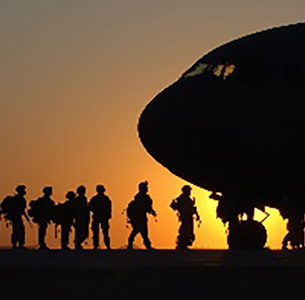
These days, the lack of connection between service members and civilians is widening; in part because less than one percent of our population serves on active duty or in the reserves. For Oregonians, the challenge is even more difficult because the state has a National Guard and Reserve presence but no active military base.
When misinformation and stereotypes about our military grow, so does the divide between service members and civilians. This divide has a serious impact on the mental health of veterans and service members as well as their sense of community. “The military is a culture, just like any other,” says Heidi Squier Kraft, clinical psychologist for the PsychArmor Institute. “Military people, like those from any culture, have certain beliefs, practice certain rituals and traditions, and hold fast to certain ideals.”
Less than 0.01 percent of Oregon’s population is serving on active duty. Meanwhile, Washington is seventh in the nation for the number of active duty military (3.9 percent), mainly due to Joint Base Lewis McChord and Puget Sound Naval Shipyard.
Civilians may find boundaries between themselves and service members because of myths and generalizations about military culture. Ensuring our ideas are accurate will help us gain serious ground toward breaking down barriers between civilian and military communities. Here are five myths we think are worth debunking:
Myth 1: Fewer young people are serving in the military.
Reality: While the average age of our military has increased over time, in 2016 about 80% of active duty military members were age 35 and younger. Millennials make up about 35% of the total military pie chart, and the newest generation—the Network Generation (age 25 and younger)—is over 50% of the total active duty population.
Myth 2: The military is not very diverse.
Reality: The diversity of our military continues to change. Women are now 16% of our active duty military (up from 11% in 1990), and racial and ethnic minority groups make up about 40% of the active duty military. While whites and Blacks are slightly overrepresented in the military (in relation to their percentage of the total US population), Hispanics are significantly underrepresented in the military. However, the Hispanic population of our military (12% of all active duty in 2015) has increased threefold since 1980.
Fun fact: Oregon’s Department of Veterans Affairs is only one of two in the country that has a women’s coordinator, and the only department in the country with a dedicated LGBTQ coordinator.
Myth 3: People who are poor or uneducated are overrepresented in the military.
Reality: US soldiers are more likely to come from middle- to upper-middle-class backgrounds. They may have fewer academic degrees compared to their college-age civilian counterparts, yet that’s primarily because people enlist in the military before going to college so that they can take advantage of the free education opportunities provided by the GI Bill.
People serve in the military for a variety of reasons, including: education, opportunity to travel, patriotism, opportunity to be a member of a strong team, meaningful work, and a chance to be play a role in history.
Not surprisingly, [people in the military] don’t appreciate being stereotyped as poor, uneducated or desperate. These perceptions color the public’s views of what veterans are capable of doing when they return home.
Fun fact: “Soldiers” are only in the Army, and the Army is only one of four branches of our military.
Myth 4: Everyone in the military engages in combat.
Reality: Not everyone in the military is on-the-ground like in TV shows and movies. People in the military serve in a wide range of jobs, including: mechanics, cooks, pilots, sailors, divers, administrators, doctors, musicians, weapons specialists, military police, air traffic controllers, and many more. Just over 50% of our military is made up of people who serve in a ready-reserve capacity (i.e., Air Force/Army/Marine/Navy Reserves, National Guard, Coast Guard Reserves). These individuals work regular, civilian jobs, but are ready to leave at a moment’s notice to serve the military.
Myth 5: Military families are just like all other families.
Reality: Military families have an incredibly challenging job. Not only do they go through long separations from their loved ones, but on average, they may move six to eight times during a military career. That means six to eight new homes, schools, jobs, friends, routines, and neighborhoods. Military families endure an enormous amount of change—most often every two to four years.
3 Things You Need to Know About Women Veterans Today >
3 Things Local LGBTQ+ Veterans Want You to Know >
Myth Busting: Check Your Knowledge of Veterans Issues >
Myth Busting - Military.pdf
Originally published December 5, 2018.
Share this online:


